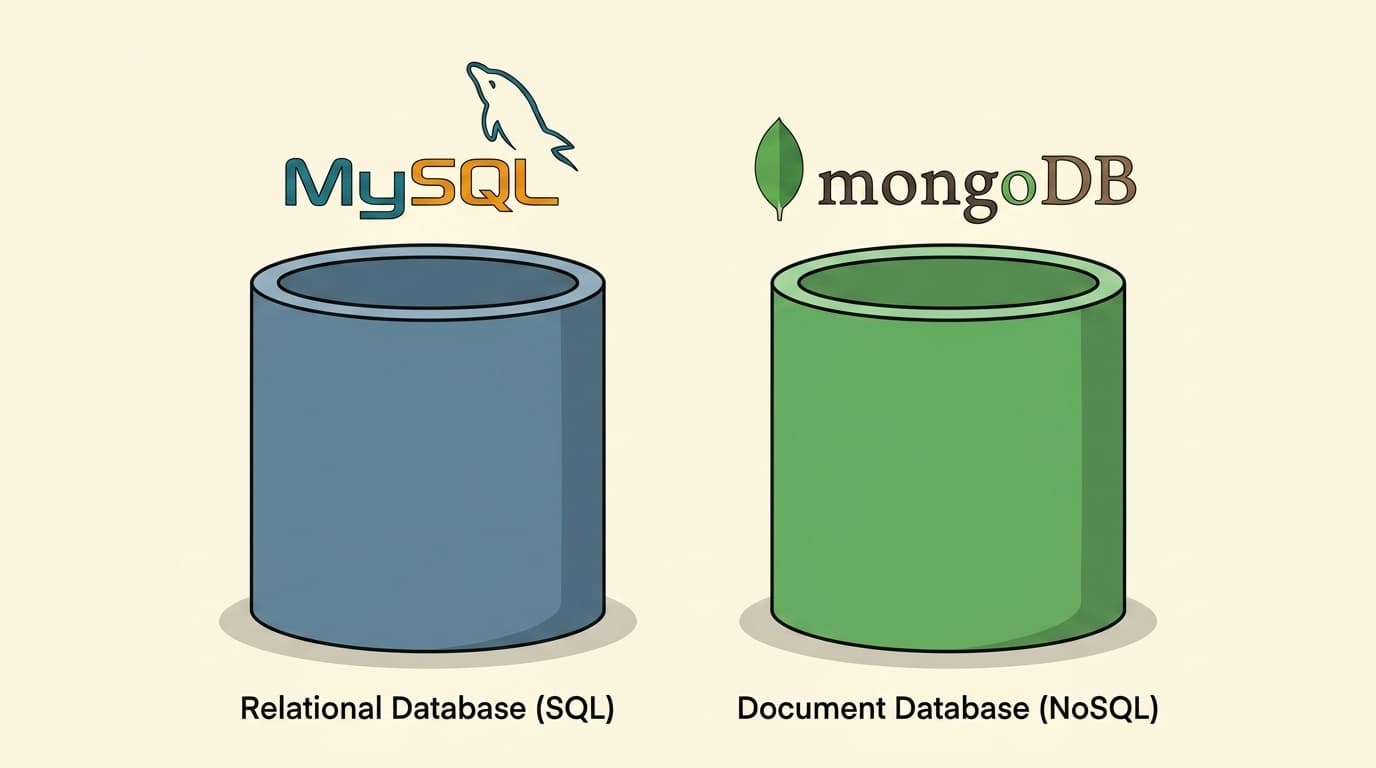
Somewhere around 2015, NoSQL became a personality. MongoDB was the future, SQL was legacy, and anyone who questioned that was just not thinking at scale. Then a lot of startups spent years migrating back to Postgres. The pendulum swung. Now people say SQL is always the answer and document databases are a mistake.
Both positions are wrong. The right database depends on what you are building.
What MySQL Is Good At
MySQL is a relational database. Data lives in tables with rows and columns. Relationships between tables are defined by foreign keys and enforced by the database. Queries use SQL, which has been standardized for decades and is one of the most transferable skills in software development.
MySQL is the right choice when your data is structured and predictable. An e-commerce platform has orders, line items, products, and users that relate to each other in fixed ways. A banking system has accounts, transactions, and balances that must be consistent. A CRM has contacts, companies, and activities. All of these fit naturally into tables, and SQL gives you the tools to query across them efficiently.
The killer feature of a relational database is the JOIN. The ability to query across multiple related tables in a single operation, with the database handling the relationship logic, is something document databases make you do in application code instead. That is fine for simple cases and a mess at scale.
What MongoDB Is Good At
MongoDB stores data as documents, which are essentially JSON objects. A document can contain nested objects and arrays without needing separate tables. This is genuinely useful when your data is hierarchical or when the shape of your data changes frequently.
A content management system where every post type has different fields is a good fit for MongoDB. A product catalog where different product categories have different attributes works well as documents. An event log where each event has a different payload is another good match.
MongoDB also scales horizontally more naturally than MySQL. Sharding a document database is more straightforward than sharding a relational one. If you are building something that genuinely needs to distribute across many machines due to write volume, MongoDB's architecture handles that more gracefully.
The Schema Question
MongoDB is schema-less by default, which sounds like freedom but often becomes a liability. When there is no enforced schema, different parts of your codebase write slightly different shapes of data, and you end up with inconsistencies that are hard to fix. MongoDB does support schema validation, and you should use it, but at that point you are adding back the structure you removed.
MySQL enforces schema at the database level. Migrations are more work upfront but they create consistency that pays off as the codebase grows and more developers touch the data layer.
Performance
Both are fast. For most applications, the difference in query performance between MySQL and MongoDB is irrelevant compared to whether you have the right indexes, whether you are fetching too much data, and whether you are hitting the database too often.
The performance conversation only matters at scale, and at scale the answer depends more on your access patterns than on which database you chose.
The Practical Answer
If you are starting a new project and you are not sure which to pick, pick MySQL or Postgres. The relational model forces you to think about your data structure clearly, SQL is a skill that transfers everywhere, and you can always add a document store later if you have a specific use case that benefits from it.
Pick MongoDB when you have a genuine reason: the data is truly document-shaped, the schema changes faster than migrations can handle, or you need horizontal write scaling that SQL cannot give you without significant complexity.
The worst reason to pick MongoDB is that it feels more modern. The data model is the foundation everything else is built on. Get that decision right and most other problems are manageable.